

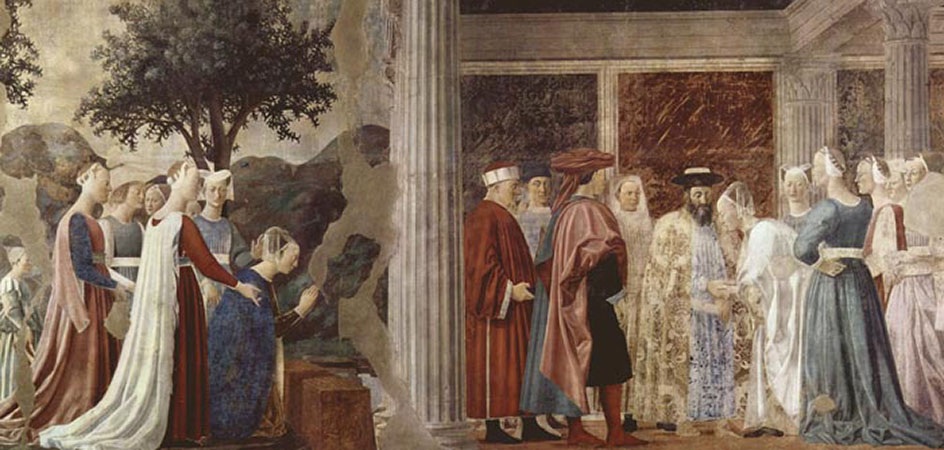
The Leggenda della Vera Croce in the Cappella Bacci of the Basilica of San Francesco in Arezzo is one of the most spectacular and innovative fresco cycles of the Renaissance, and one of Piero della Francesca’s absolute masterpieces. The chapel has now been fully converted into a museum and can now be visited in small groups: inside, the great artist’s painting reveals its beauty in full, thanks also to the masterful restoration that, after fifteen years, has restored its colours and expressive power. But what does it represent, and what makes this work so groundbreaking?
Origin and subject of the work
Commissioned to decorate the Cappella Bacci —the basilica’s main chapel—between 1452 and 1466, Piero della Francesca executed, together with a number of assistants (probably including Giovanni da Piamonte), the frescoes that still cover the walls of the space today. Across the three full-height registers, he depicted the most significant episodes of the Leggenda della Vera Croce, drawn from the Legenda Aurea, a collection of hagiographic biographies composed around 1265 by the bishop of Genoa, Jacopo da Varazze, and still widely known in the fifteenth century. The subject was perfectly in line with the context in which the artist worked. In fact, the Franciscans—custodians of the basilica and traditionally devoted to the Cross—had already adopted it in various other churches. Their bond with Rome and the papacy was also evident: the latter had sided with them in favour of a crusade against the imminent Turkish threat. Furthermore, according to tradition, Arezzo had converted to Christianity very early, during the reign of Constantine. Within the framework of the Leggenda, Piero inserts explicit references to all these themes, achieving a balance that reconcile narrative demands with the pressing concerns of his own time.
A complex and varied narrative
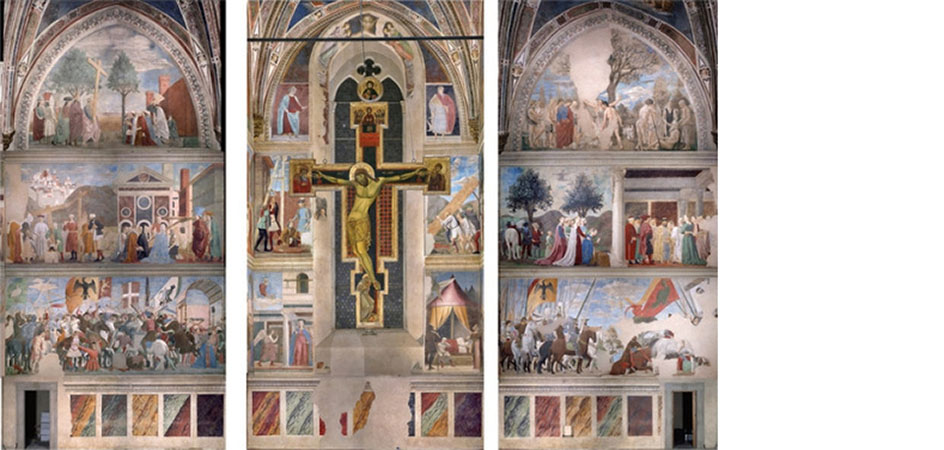
Among the distinctive features of this imposing fresco cycle is the arrangement of the various scenes. They do not follow a chronological sequence, nor are they organised according to the classic reading order (top to bottom, left to right). Instead, they are positioned on the three walls (right, left, and central) according to thematic and iconographic correspondences. Although this may seem unusual today, it was not at all unprecedented at the time: similar solutions can be found, with due variations, in Giotto’s frescoes for the Cappella Bardi (Florence, Santa Croce) or in Simone Martini’s frescoes in the cappella di San Martino (Assisi, Basilica Inferiore di San Francesco).
The novelty lies above all in the painterly execution, the composition, and the interplay of light and colour—qualities that only Piero’s hand could achieve while constantly evolving his visual language. The two lunettes at the top provide clear evidence: the sky, densely clouded on the right, brightens markedly in the one on the left; the depiction of the trees, more summary on one side, becomes precise and detailed on the other; the volumes and use of perspective grow increasingly sophisticated and functional to the narrative. And it is from one lunette to the next, all the way down to the Annunciazione, that the story unfolds, articulated into ten episodes according to a precise reading order.
The scenes and how to read them
We begin with the left lunette—which must be read from right to left—where La morte e sepoltura di Adamo is depicted. From here, the gaze descends to the register below where, now following the narrative in the opposite direction in a zig-zag pattern, we encounter the Adorazione del Sacro Legno e l’incontro tra Salomone e la Regina di Saba. The sequence continues on the central wall, remaining on the same level to observe thetrasporto del Legno della Croce. We then move down a register to admire the captivating Sogno di Costantino, which will be discussed later.
We next turn to the right wall, to the first of two battle scenes. Although damaged by time, it represents theVittoria di Costantino su Massenzio. Despite the losses, Constantine’s outstretched arm—brandishing the Cross that puts the enemy to flight—is still clearly visible.
The sixth episode, also on the central wall but on the upper left level, depicts the tortura dell’ebreo. Here the architectural structure dominates the composition, just as it does in the episode below (the tenth and final one), the Annunciazione. Before reaching it, however, we must look at another part of the story. In the middle of the left wall is the ritrovamento e il riconoscimento della Vera Croce, whose background reveals a view of Arezzo in the distance. In the original narrative, this episode is set in Jerusalem: a poetic licence that underscores the symbolic bond between the Tuscan city and the sacred events. Just below, the Battaglia di Eraclio contro Cosroe, unfolds: amid a gripping clash of men and horses, we also witness the execution of the pagan king.
We now return our gaze to the upper left lunette, where the esaltazione della Croce is depicted: the Christian symbol stands out within the vaulted space and also as the concluding emblem of the cycle. With a decidedly more intimate yet no less solemn tone, the Annunciazione ultimately closes the narrative.
The Leggenda della Vera Croce: three scenes worth focusing on
Beyond the reading order, which is essential for understanding the unfolding of events, a full view reveals an immediate thematic and formal correspondence between the two sides—a harmonious and symmetrical arrangement that enhances the overall beauty. Among all the episodes, three in particular deserve closer attention for the way they demonstrate the artist’s talent and innovative vision.
The Sogno di Costantino
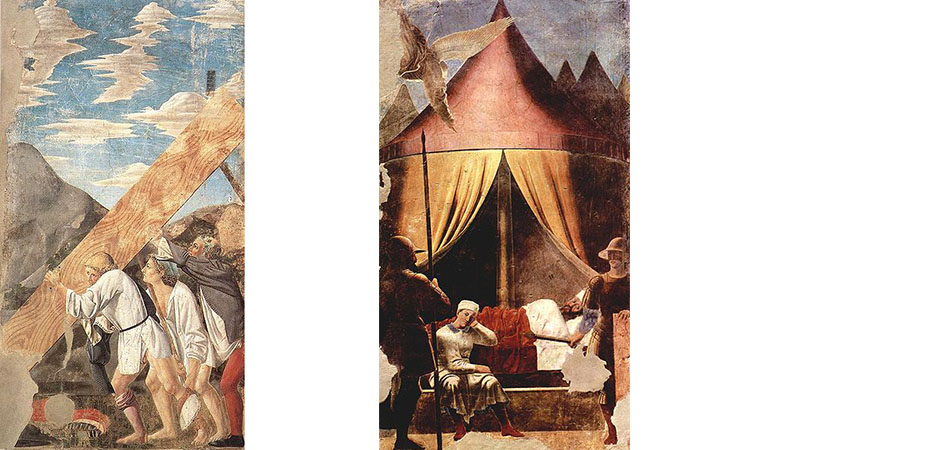
Not a nocturnal scene, as long believed before the recent restoration, but a dawn. It is in the earliest hours of the day that the angel appears to Constantine, still immersed in sleep. The celestial messenger descends from above, bearing the Cross and assuring the emperor that it is the key to victory over Maxentius: “In hoc signo vinces” are his words. His arrival is accompanied by a light that—through one of the most striking and poetic solutions in art history—illuminates the tent and its interior. The light brushes the soldier standing guard on the right, while leaving the one on the left in an striking backlit contrast. None of the figures, not even the young man in the foreground who looks directly at the viewer, seems aware of what is happening. In the distance we glimpse the tips of the encampment, while a starry sky, just touched by the first rays of the rising sun, closes the scene. The entire composition is suffused with an intimate, magnetic dreamlike atmosphere in which divine light emerges as the true protagonist.
The Battaglia di Eraclio contro Cosroe
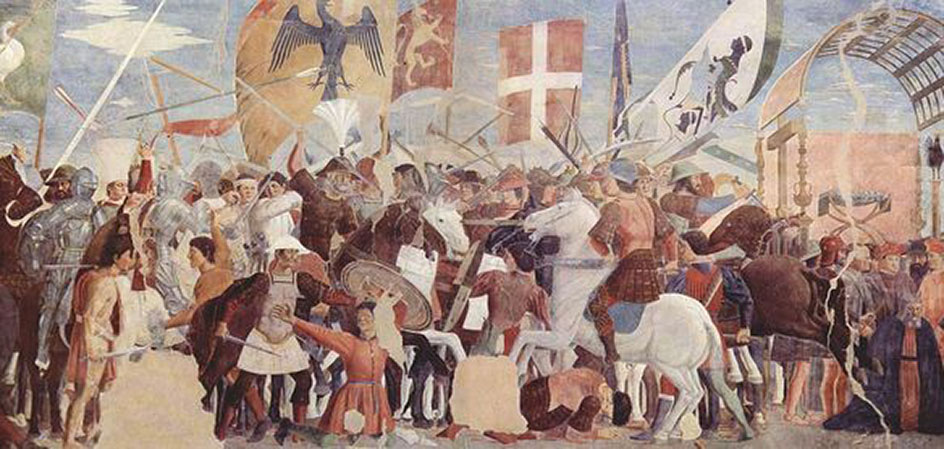
Completely different in tone, the Battaglia di Eraclio contro Cosroe reveals Piero’s ability to master radically different registers—from the quietude of an emperor’s sleep to the turmoil of a brutal clash. And so we are thrown into the midst of a crowded mêlée with men and horses, so dense that we can almost feel the tension of the charge. The two armies press against each other in a tangle of weapons and bodies that heightens the violence of the episode, visible in the terrified faces, the figures collapsed on the ground, and the bloodied swords raised to the sky. On the left, Heraclius’ troops advance unchallenged, cutting through air and enemy with an impetuous charge that overwhelms their opponents. Their Roman-inspired armour, richly coloured, seems more suited to a theatrical performance than a battlefield, yet appears far more appropriate than the elegant civilian attire of Chosroes’ warriors. The dynamism of the scene is further emphasised by the standards: the Christian banners—the imperial eagle, the rampant lion, and the white cross on a red field—stand proudly at the centre, while the pagan ones (a black collapsed flag, one with severed Moorish heads, and another with six-pointed stars and a Turkish crescent) seem to dramatically recede to the right.
Here, at the edge of the wall, beneath a canopy of impeccable perspective, we witness the condemned king’s execution, surrounded by figures believed to be members of the Bacci family, who commissioned the work.
A hallmark of Piero’s style—evident throughout the Basilica and especially in this scene—is his ability to combine the sobriety of the figures with the intensity of their gestures, stillness with tumult, and hieratic calm with courtly elegance.
The Annunciazione
In a perfect counterpart to the sogno di Costantino, the Annunciazione closes the cycle. Although not part of the Legenda Aurea, it was likely included as an allusion to Salvation, embodied in Christ’s coming. Mary appears within a loggia adorned with marble and intricate carvings. To her right, the announcing angel arrives bearing a palm branch, symbol of victory, while above, God the Father sends the Holy Spirit in the form of light. Her expression is calm and assured, and it is intriguing to note that Piero used the same preparatory cartoon for her face as for Chosroes: the two share the same features.
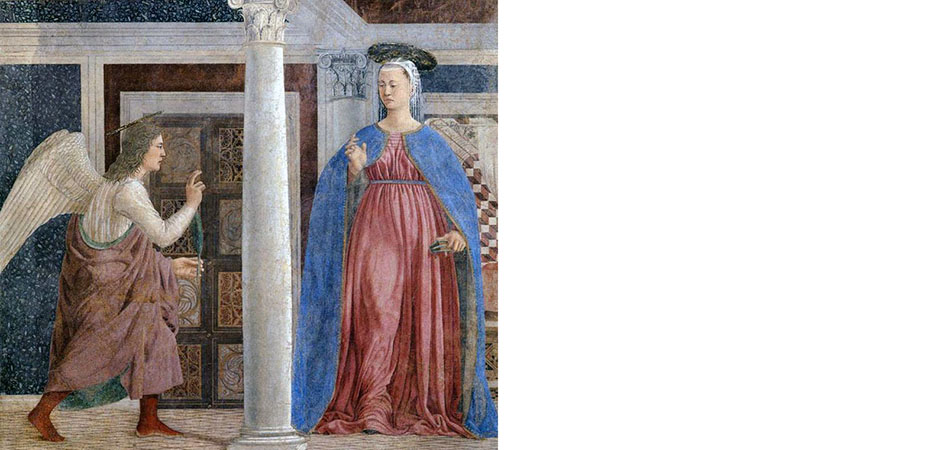
The central column, illuminated by divine rays, appears to symbolise Mary’s virginity and strength, as the supporting pillar of the Church. Yet what truly astonishes, beyond the architectural setting, is above all the Virgin’s expression. Here – unlike what usually occurs in the Annunciazione scenes – there is no fear, no submission. Mary receives the divine message with dignity and solemnity: she is calm, steadfast, already aware of her destiny, and the entire scene is imbued with this quiet resolve.An unmissable stop for anyone visiting Arezzo, the Leggenda della Vera Croce is one of the finest examples of Piero della Francesca’s art, but it is not the only one to be found in the city. The cathedral, in fact, is home to his Maddalena. Although the two works differ in subject and compositional complexity, they share a common backstory: the model for this second fresco may have been Bonanna Bacci, a young noblewoman from the same family that commissioned the paintings in San Francesco. At the time of the Maddalena, the Bacci family were apparently behind on payments for the Franciscan cycle and, out of spite, Piero is said to have immortalised her in the guise of the famous sinner within the city’s cathedral.
A decidedly human touch, one that few would imagine when confronted with the majesty of his great masterpiece in Arezzo.