

“There is a young man from Cento who paints with such felicity of invention, is a great draughtsman and a most skilful colourist…” With these words Ludovico Carracci (1555–1619) described in a letter the talent of Giovanni Francesco Barbieri, known as Guercino (1591–1666). Born in Cento, near Ferrara, Guercino showed a remarkable inclination for painting from an early age, which first led him to Bologna – where he came into contact with the great Emilian master – and then to Rome, in the service of the papal court.
The Eternal City still preserves some of the most memorable works of his entire production, precious testimonies of a new, personal and astonishing artistic language.
From Cento to Rome and back again: the years of training and rise to success
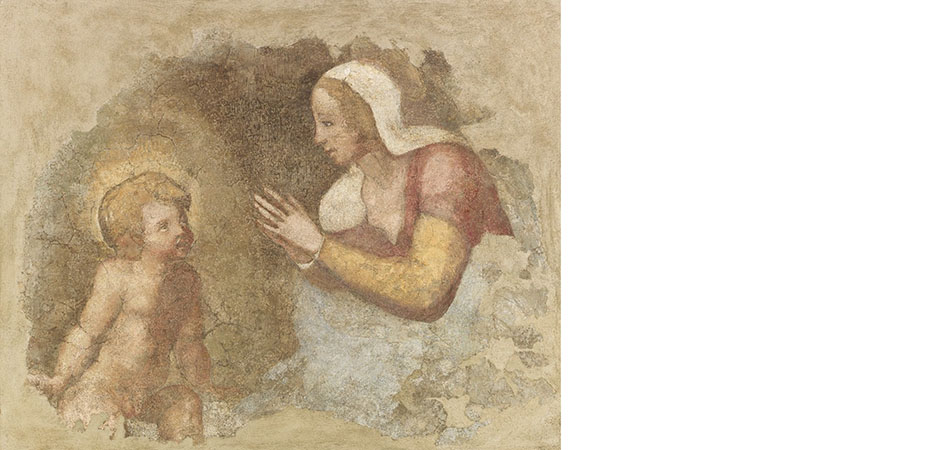
Precocious and unstoppable, Guercino’s talent emerged very early. Some biographical sources report that at only eight years old he created, with makeshift materials, his first work: a fresco of the Madonna di Reggio, also known as Madonna della Ghiara, of which a fragment survives today (1598–1599, Cento, Civica Pinacoteca il Guercino). Between the ages of nine and seventeen he trained in the workshops of various Bolognese painters, from whom he learned technique more than style: his artistic voice was, from the start, that of a “soloist”, a third path between Caravaggio’s theatrical naturalism and the balanced harmony of the Carracci.
This distinctive quality earned him the admiration of his peers and his first important commissions.
Not yet thirty, Guercino met in Bologna Alessandro Ludovisi, the Archbishop of the city, who was greatly impressed by his work. When Ludovisi was elected pope in 1621, taking the name Gregory XV, he instructed his nephew Ludovico Ludovisi – cardinal and close advisor – to summon the painter to Rome. Guercino’s Roman stay lasted only two years, ending with the pope’s death, but it proved decisive for his career.
His rough style and his dark, strongly contrasted colour palette – which anticipates certain eighteenth-century solutions – were well received by both the ecclesiastical circles and the local nobility. This is confirmed by the continuity of his ties with Rome, which persisted even after his return to Cento, where – according to historians – his art began to shift towards more Carraccesque solutions.
3 masterpieces by Guercino in Rome
Rome still preserves numerous masterpieces by Guercino, works created during his stay in the city or brought here in different periods. We have selected three examples which, differing greatly in type and subject matter, reveal the unique qualities of his painting and its evolution over time.
Et in Arcadia, ego: an enigmatic early work
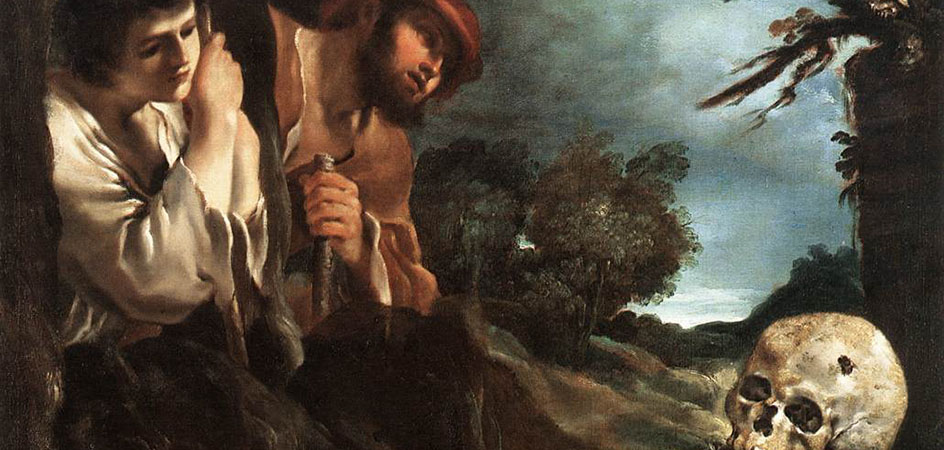
Painted between 1618 and 1622, before his move to Rome and after his trip to Venice, Et in Arcadia, ego is perhaps Guercino’s most mysterious canvas. The patrons and reasons that led him to create this dark-toned memento mori are unknown, though the painting’s presence at Palazzo Barberini’s Galleria Nazionale d’Arte Antica is documented as early as 1644.
Against the backdrop of a rural landscape, dominated by a twilight atmosphere that forebodes an approaching storm, we see two shepherds gazing at a skull. Their expressions reveal their sombre astonishment at the macabre discovery. Beneath the skull is the inscription “Et in Arcadia, ego” – “Even I, Death, am in Arcadia”. The myth of Arcadia, narrated by Tacitus and Virgil, was rediscovered and widely celebrated in the sixteenth century as an idyllic ideal of pastoral life far from worldly toil. A harmony shattered by death, symbolised by the skull. The fly and the mouse hint at an ongoing state of decay, while the caterpillar on the right suggests themes of transformation and the slow passing of time. The owl perched on the highest branch symbolises darkness and shadow, which the thin ray of light filtering through the foliage struggles to dispel as it illuminates the young shepherd’s face.
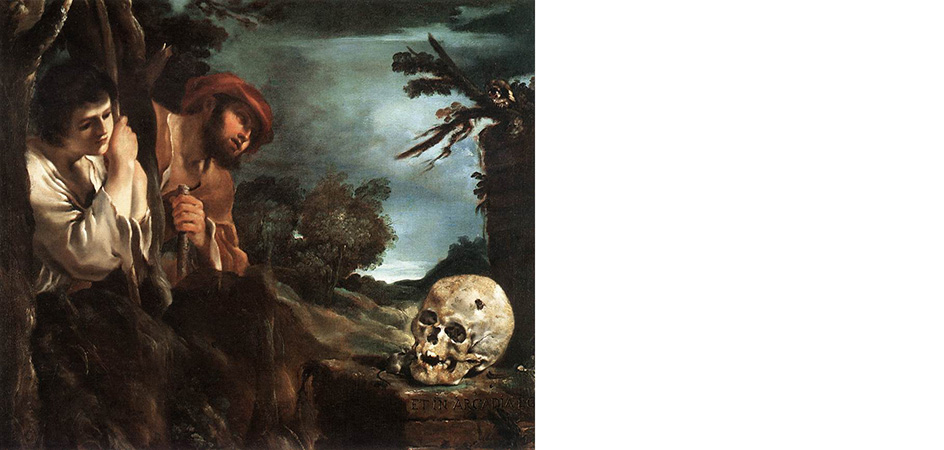
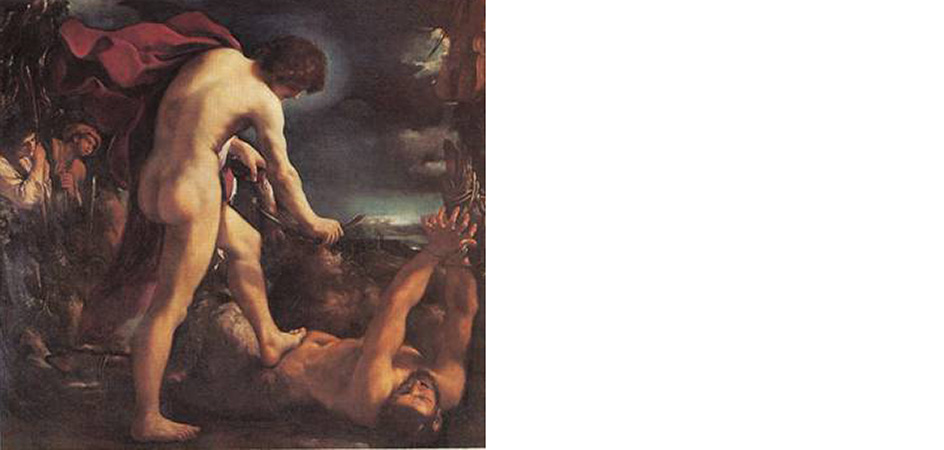
The most accepted theory about the painting’s origin arises precisely from studying the shepherds. They appear identical, in size and iconography, to those in the Apollo e Marsia, painted by Guercino for Grand Duke Cosimo II de’ Medici in 1618 (Florence, Palazzo Pitti). According to Denis Mahon, one of the leading scholars of Guercino, the Roman canvas was therefore a preliminary version of the Florentine painting, later transformed – with the addition of the skull and inscription – into a stand-alone moralising theme, very common in the Venetian area.
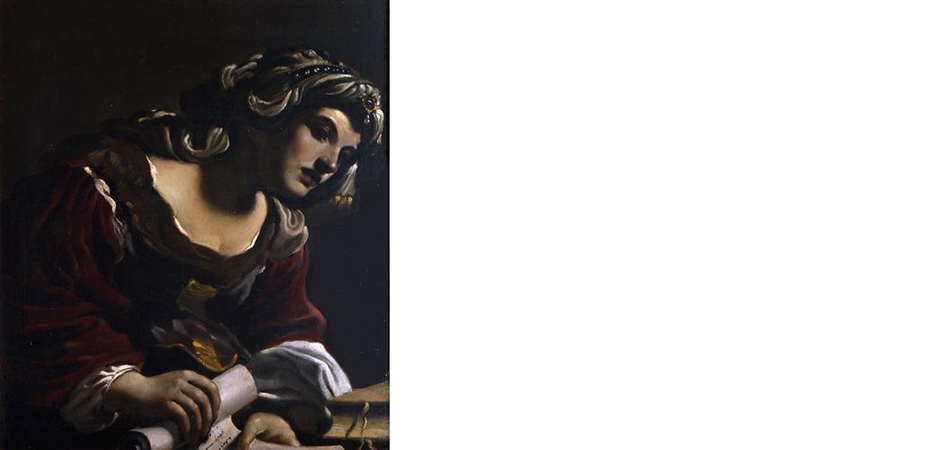
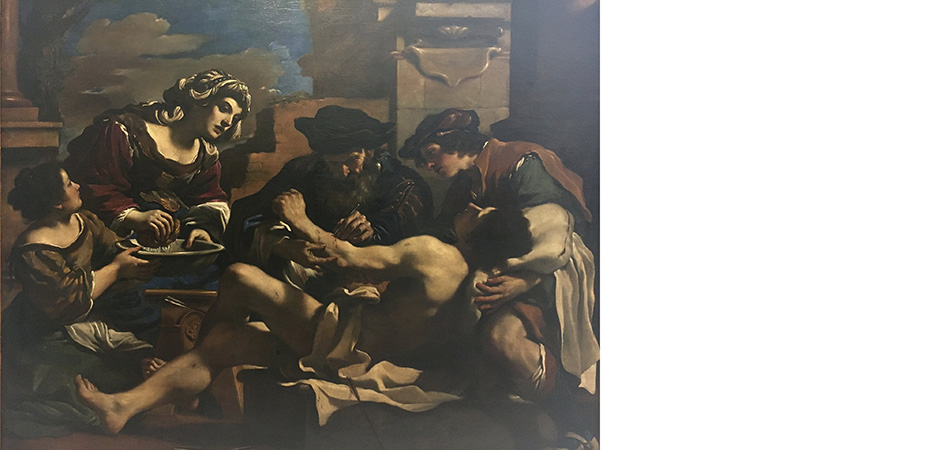
Reusing the same figures in different works was rather frequent in Guercino’s art, as seen in the female figure that appears, almost unchanged, in the Sibilla (1619) and in San Sebastiano soccorso da Irene (1619–1620) at the Pinacoteca Nazionale di Bologna.
The monumental altarpiece Santa Petronilla sepolta e accolta in cielo
Among the most prestigious commissions Guercino received during his Roman stay was the monumental altarpiece for the right transept of San Pietro. The enormous canvas (over seven metres high and more than four metres wide) depicts the burial and the resurrection of Saint Petronilla, and was originally placed directly above the monument that houses the saint’s relics in the Roman basilica. Highly venerated at the time, Petronilla has an uncertain story: according to some accounts, she was a Roman noblewoman executed for embracing Christianity during Domitian’s persecutions; others identify her as one of St Peter’s daughters, who, harassed by a pagan suitor, chose to starve herself rather than compromise her virtue and faith.
Guercino unites two moments of her story: the lower register shows her burial, while the upper portrays her ascent to heaven. This interpretation is now the most widely accepted, though others exist. Some believe the lower scene represents an exhumation instead; others interpret it as carrying a political message, where the choice of the subject emphasises the supremacy of the Catholic Church over others – a message presumably addressed to the French crown, devoted to the saint, which had sided with the Calvinists during the Thirty Years’ War.
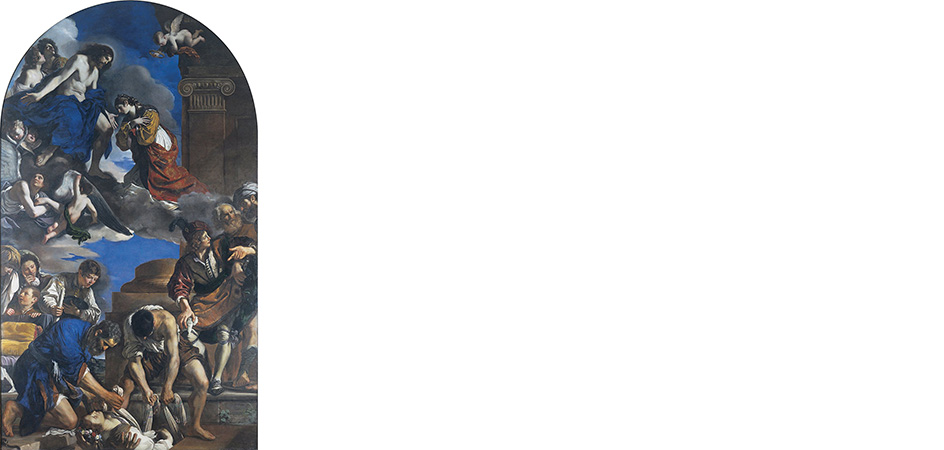
In any case, the work long stood as Guercino’s greatest Roman masterpiece and today it is seen as belonging to a specific phase in his artistic development: a transitional moment between his youthful style – marked by a more pronounced and vigorous naturalism – and his mature compositions, calmer and more classicising in taste, closer to the painting of the Carracci. The upper section, with the saint kneeling elegantly before Christ and bathed in an unifying light, prefigures this gradual evolution.
Among the most successful inventions is the illusion of depth in the tomb, heightened by the two hands emerging from the excavation to receive the woman’s lifeless body, positioned exactly where her funerary monument stands.
In 1730 the painting was replaced with a mosaic version and moved to the Sala Regia of Palazzo del Quirinale. Taken to France during the Napoleonic spoliations, it returned to Italy in 1818 and, following Antonio Canova’s recommendation, was placed in the Pinacoteca Capitolina, where it remains today.
The ritratto di Bernardino Spada: the human side of a high ecclesiastical office
Portraits are relatively rare in Guercino’s oeuvre, and the portrait preserved in the magnificent Palazzo Spada stands out for its intimate and human tone. It is 1631, and Cardinal Spada is hosting the painter at his own expense in his house in Bologna so the portrait may be completed. At that time, Bernardino Spada held several prestigious positions: papal nuncio in Paris, Archbishop of Damiata, intermediary with Louis XIII and confidant of Maria de’ Medici, Queen of France. Yet none of this is evident in the painting, which portrays him half-length, slightly turned three-quarters, holding a drawing of an eight-pointed ground plan. This was a deliberate choice, taking him back to a few years earlier, when he was “simply” the papal legate of Bologna (1627–1631), actively involved in the project of the urban fortress of Castelfranco Emilia, near Modena. He had laid the first stone on 25 October 1628, and this is the building reproduced on the sheet he holds.
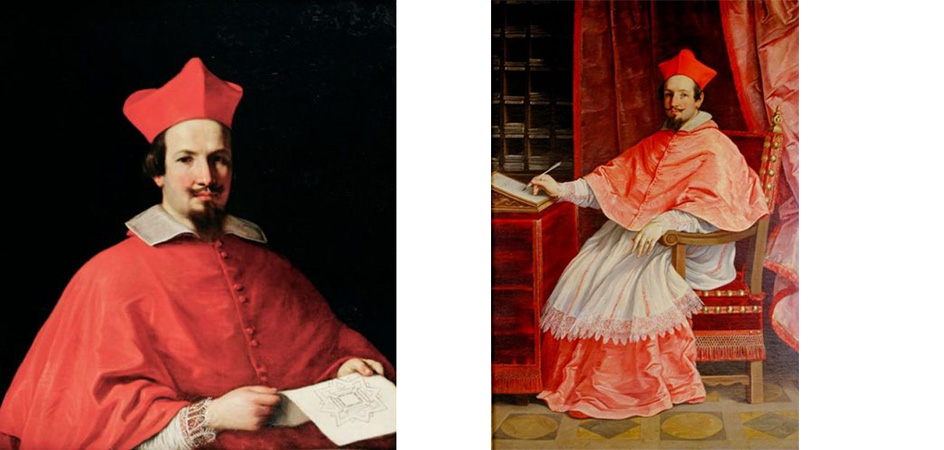
The cardinal’s expression is kindly yet thoughtful, focused on overseeing the demanding construction project. No further details are offered: devoid of any setting, the dark, compact background enhances the sitter’s features and his gentle, contemplative expression. The only aesthetic concessions are the rosy tone of his garment and the lace on his right sleeve. An intensity deliberately sought by the patron, who in the same period also commissioned Guido Reni – a highly renowned painter in Bologna and a “rival” of Guercino – to produce a second portrait (also housed in the Galleria Spada).
The contrast between the two paintings could not be more telling: where the canvas by the artist from Cento emphasises the human and emotional qualities of the prelate, Reni’s instead highlights his authority and solemnity, depicting him in his study as he writes a letter to the pontiff. A dual perspective which, thanks to the juxtaposition of the two works, provides a complete image of the cardinal.
Forced to leave his beloved hometown for safety reasons (Cento, lacking defensive fortifications, was exposed to potential military attacks), Guercino moved permanently to Bologna in 1642. That same year Guido Reni died, and Guercino – by fortunate coincidence – inherited many of his commissions.
He spent the last twenty-five years of his life in Bologna, where he died in 1666, by then universally recognised as one of the leading figures of the Italian Seicento.