

There are few places in the world capable of transporting us back in time. Tuscany, with its art cities and ancient villages, is undoubtedly one of them. Together with Florence and Siena, Arezzo is steeped in a past that is still alive today, visible in its places and artworks – works that preserve their precious historical dimension. Let’s retrace them together.
Piazza Grande
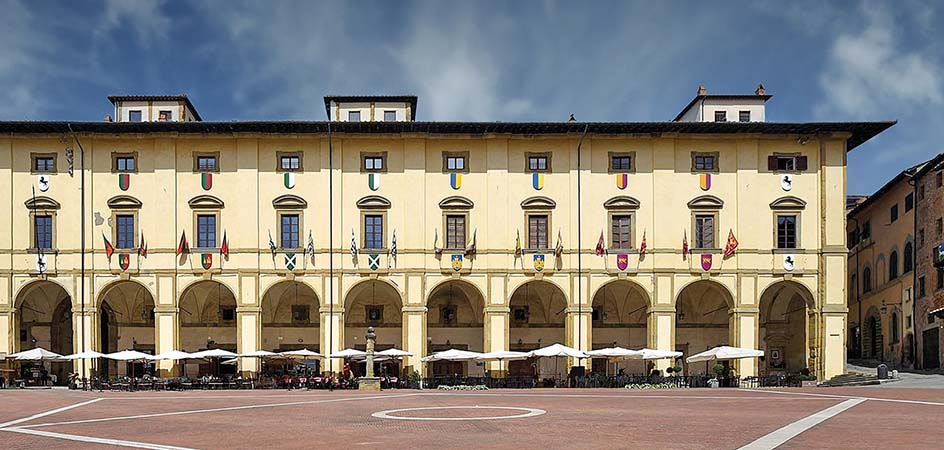
We begin in the heart of the city, Piazza Grande, distinguished by its unusual trapezoidal shape and steeply sloping pavement. Here stand buildings from different periods and styles: ancient towers and medieval or medieval-revival houses (some of which were rebuilt in the twentieth century during a wave of cultural and architectural revival), the Romanesque apse of the Pieve di Santa Maria Assunta, and iconic Renaissance structures such as the Palazzo delle Logge. Designed by Giorgio Vasari1 in 1573 for the Fraternita dei Laici (a city institution founded in 1262), its elegant arcades offer visitors a delightful stroll. But this was not always the case: a curious plaque, once set into one of the pillars (now replaced by a copy), reminds us that in the sixteenth century this area was reserved for the city’s rulers and nobility, and that the “common people” were forbidden from walking through it.
Museo Nazionale d’Arte Medievale e Moderna
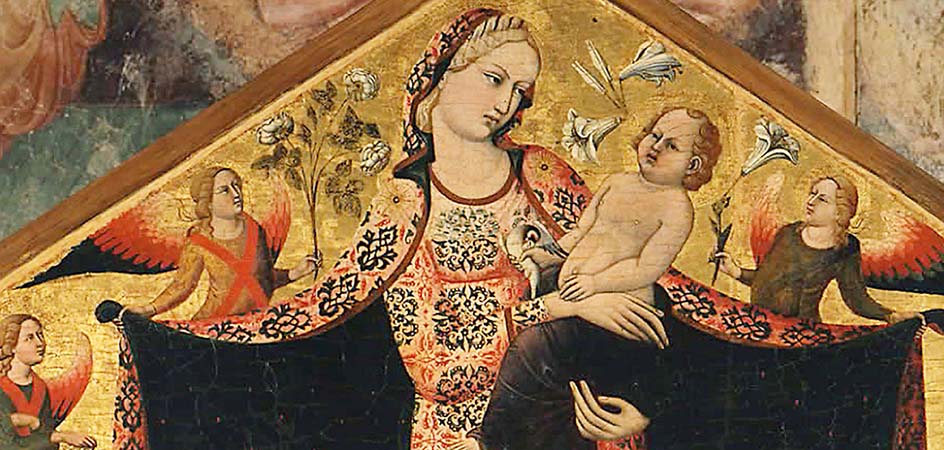
To admire the original plaque, you need to head to theMuseo Nazionale d’Arte Medievale e Moderna which, inside the unique setting of the fifteenth-century Palazzo Bruni Ciocchi, preserves an exceptionally rich heritage of historical artefacts and artworks. The visit unfolds across twenty rooms arranged chronologically, from the Early Middle Ages to the Macchiaioli.
Among the finest sculptures are San Michele Arcangelo and statues of the Madonna col Bambino that once stood above the city gates. The museum also boasts important figures from the Renaissance and Baroque, including Luca Signorelli, Giorgio Vasari, Salvator Rosa and Carlo Dolci, to name just a few. Lovers of the applied arts will particularly appreciate the collection of Renaissance maiolica, one of the most complete and striking in Italy.
Museo di Casa Vasari
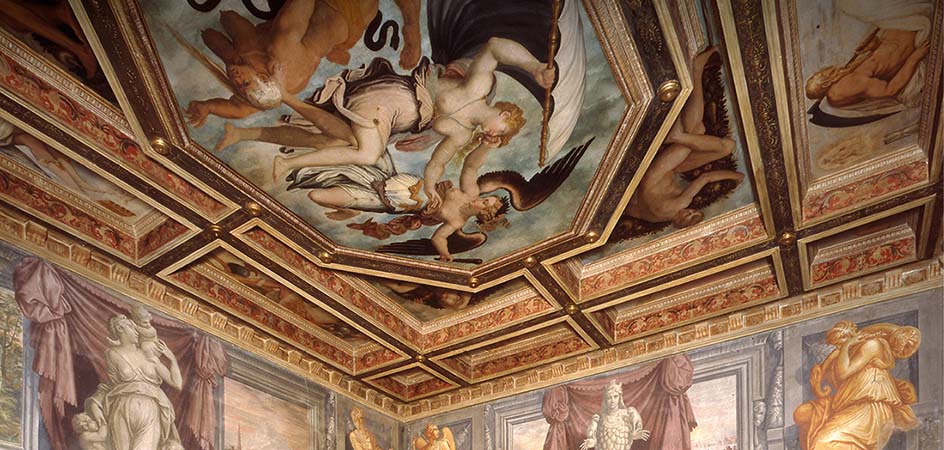
A short distance from the Museo Nazionale d’Arte Medievale e Moderna, along Via XX Settembre, stands the Museo di Casa Vasari. “A house begun in Arezzo, with space for beautiful gardens in the Borgo San Vito, in the best air of the city”: this is how Vasari himself – architect, artist and writer – described his residence which, despite being able to spend only little time there, he loved dearly and personally decorated. The pictorial decoration of the piano nobile, with its painted coffered ceilings, frescoed vaults and wall paintings, continues to enchant visitors today. Allegorical, mythological and biblical scenes intertwine with masterful chromatic and compositional harmony, following a precise programme intended to celebrate the figure of the artist. Since 1950, these have been joined by a small picture gallery featuring works by Vasari and the so-called “painters of the studiolo”, who decorated the study of Francesco I de’ Medici in Palazzo Vecchio in Florence. Outside lies the Italian-style hanging garden (once even larger), where the charm of nature immediately reveals the reason for Vasari’s affection towards this elegant yet welcoming home.
Cimabue’s Crocifisso in the Church of San Domenico
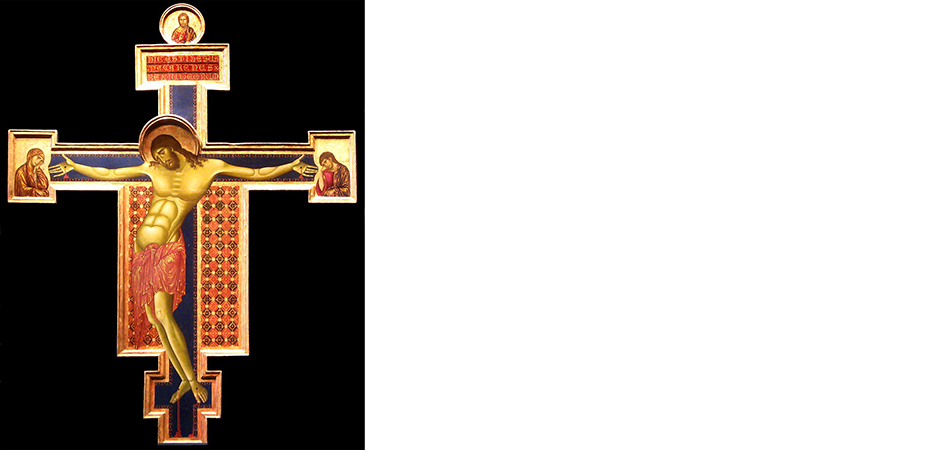
In his Vite, Vasari hails Cimabue as the first great innovator of Western painting. One of his masterpieces is the imposing Crocifisso dominating the main chapel of the Basilica di San Domenico. Created between 1265 and 1271, it is considered Cimabue’s youthful masterpiece. The model is that of the suffering Christ: the wounded body leaning to one side, the head bowed, the eyes closed in an expression of pain. The same sorrow appears on the faces and in the postures of the Madonna and St John the Evangelist, placed respectively to the left and right of the Redeemer. Above is a half-length Christ standing over the inscription “Hic est Iesus Nazarenus Rex Iudeorum” (“This is Jesus of Nazareth, King of the Jews”, commonly abbreviated as I.N.R.I.). Cimabue likely drew inspiration from the Bolognese Crocifisso by Giunta Pisano, who first renewed the iconography of Christ on the Cross. Yet Cimabue introduced innovative elements, moving away from the Byzantine tradition: a more pronounced chiaroscuro on the abdomen to give the volumes greater three-dimensionality; the face, enhanced by carefully placed highlights, conveys the pathos of the scene with greater realism. The result is more vivid, more human, more engaging, even though still tied to schematic conventions. It was a lesson that Cimabue’s pupils, Giotto above all, would develop to even more astonishing heights.
Museo I Colori della Giostra
Drumrolls and trumpets, waving flags and a parade of more than four hundred people in medieval costume: the re-enactment of the Giostra del Saracino takes Arezzo and its inhabitants back through the centuries. This event, which excites both locals and visitors alike, is held twice a year in Piazza Grande. Here, the city’s four districts – Porta del Foro, Porta Santo Spirito, Porta Sant’Andrea and Porta Crucifera, each with its own colours – compete for the Golden Lance, crafted each year by a different artist.
For those unable to attend, the exhibition on the ground floor of the Palazzo Comunale is a must. Through historical garments, artefacts, objects and immersive technologies, visitors can explore the origins and traditions of the Giostra and relive its emotions – a highly recommended stop for children too!
The Cathedral of San Pietro e Donato
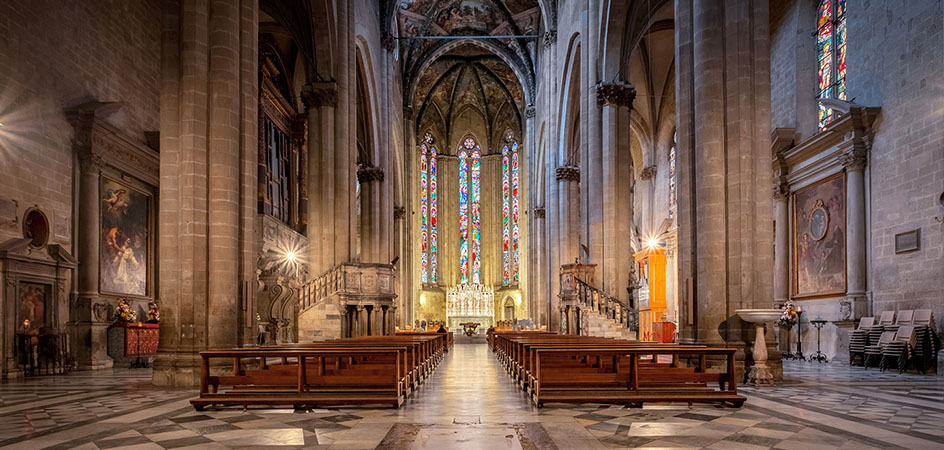
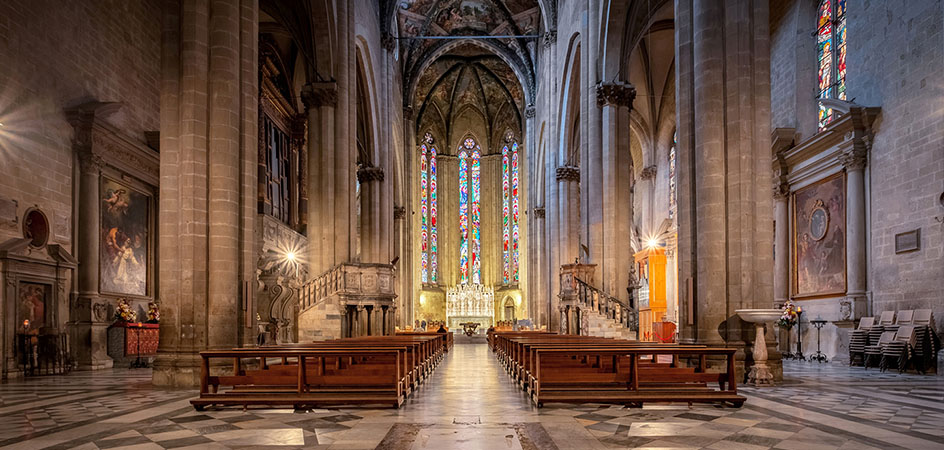
Rising on the hill of San Pietro, the city’s cathedral began construction in the thirteenth century and was completed – after numerous interruptions – in the sixteenth. What we see today, however, is the result of several later interventions: the Gothic façade dates to 1914, while the new presbytery was completed in 2012.The interior is a treasure chest of masterpieces from different eras, making this a truly extraordinary concentration of sacred art.
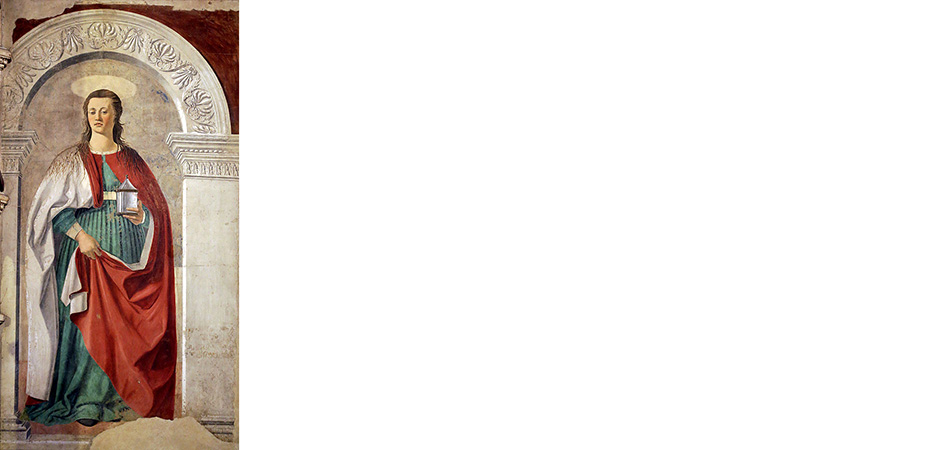
Among them is the fresco of the Maddalena by Piero della Francesca (1412–1492), painted around 1459 while the artist was working on the cycle for the Church of San Francesco, which we will discuss further on. Stern and solemn, she perfectly embodies Piero della Francesca’s style: an essential palette illuminated by masterful whites and greys, rigorous perspective construction, and a vividly expressive presence (enhanced here by her dishevelled hair).
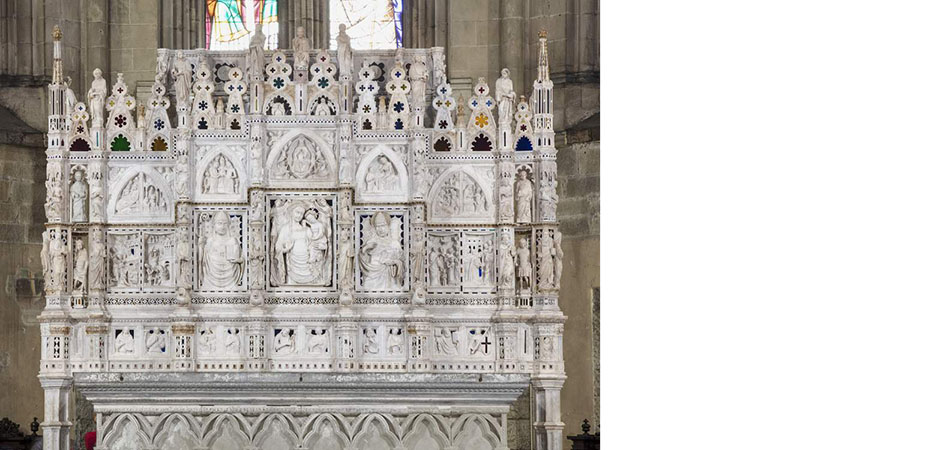
Equally striking is the marble Arca di San Donato on the high altar, with its intricate design of figures, spires and pinnacles. Created in the second half of the fourteenth century by local craftsmen, it houses the relics of Arezzo’s patron saint and other martyrs.
All around, a sequence of coloured stained-glass windows and frescoed vaults enhances the atmosphere, particularly the scenic compositions of painter and glass master Guillaume de Marcillat.
The Medici Fortress
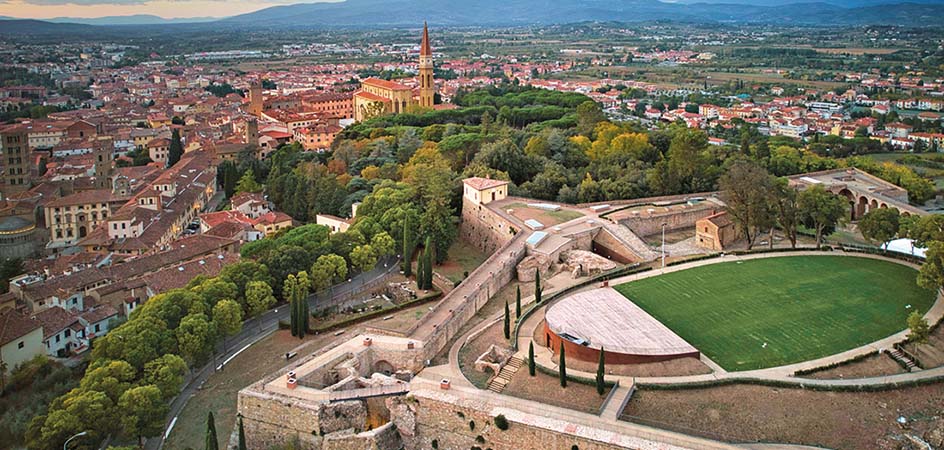
Medieval and Renaissance times were not only the age of art and culture, but also of warfare and complex military events. A testament to this is the majestic Fortezza Medicea, standing on the hill of San Donato, on the remains of the city’s earliest fortified nucleus.
A symbol of Florentine rule, the complex was built by architects Giuliano and Antonio da Sangallo and completed under Cosimo I de’ Medici, Grand Duke of Tuscany, in 1540. Originally protected by a wide moat and its strategic hilltop location, it was accessed through three gates.
Today the fortress hosts walks, exhibitions and various events, as well as offering splendid views over the historic centre.
The Basilica di San Francesco and the frescoes by Piero della Francesca
Our itinerary continues to the Basilica di San Francesco which, among Gothic walls and fourteenth-century Arezzo frescoes, houses one of the great masterpieces of the Italian Renaissance: Piero della Francesca’s Leggenda della Vera Croce. The scenes, organised across three levels on the walls of the Cappella Bacci, do not follow chronological order but thematic correspondences. Taken from the Leggenda Aurea by Jacopo da Varagine – a widely read medieval hagiographic collection – they narrate the story of the Cross on which Christ would die. Among the episodes depicted are the burial of Adam and the branch from which the tree will grow, origin of the Sacred Wood; the Trasporto del Legno; the Sogno di Costantino – one of Piero’s most accomplished images; the Tortura dell’Ebreo, the Battaglia di Eraclio contro Cosroe; and finally, the Annunciazione, to mention but a few. Painted between 1452 and 1466, these frescoes are among the artist’s finest achievements, known for their sculptural volumes, figurative harmony, mathematical precision, clear narrative structure, and masterful use of colour and light.
Museo Archeologico Gaio Cilnio Mecenate and the Roman Amphitheatre
The Museo Archeologico Gaio Cilnio Mecenate with the Roman Amphitheatre houses one of Tuscany’s most important archaeological collections, arranged across 26 rooms and complemented by an outdoor area. Named after Mecenate and built on the remains of the ancient Roman amphitheatre, it occupies the rooms of the medieval monastery of Monte Oliveto, retaining its distinctive curved layout. Inside, visitors can admire artefacts from Etruscan and Roman Arezzo, as well as a prehistoric section and several thematic areas dedicated to applied arts (ceramics, bronzes and precious objects). Standing out among these is the collection of Arezzo sigillata ware known as Arretina vasa: produced between the mid-first century BC and the mid-first century AD, popularly known as “coral vases”.
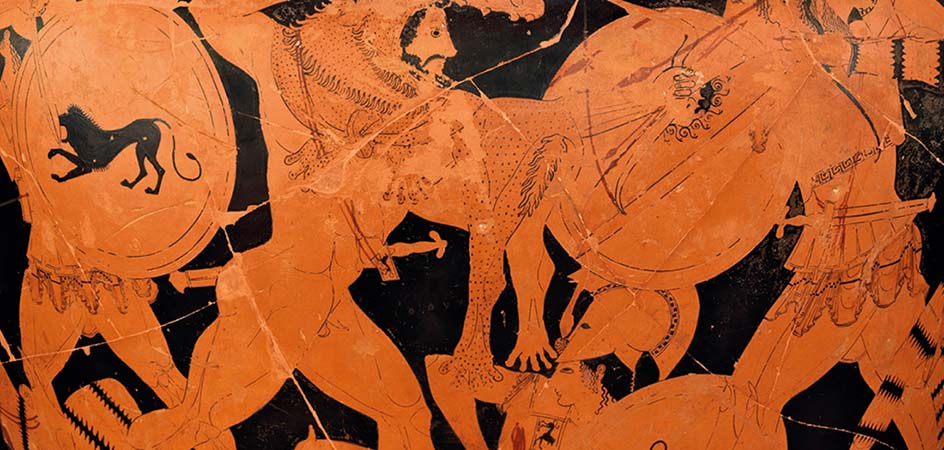
Enchanting too is the Attic krater by Euphronios (510–500 BC), a volute-krater decorated with the central theme of the Amazonomachy, the battle between Heracles and the Amazons. Lastly, the portrait of a man rendered in gold on glass (chrysography), dating to the second half of the third century AD, is a piece of rare beauty.
Rich in history, art and tradition, Arezzo offers visitors a unique experience where time truly seems to have stood still.1. Giorgio Vasari (1511–1574), artist, architect and writer at the Medici court, was also the author of Le vite de’ più eccellenti architetti, pittori, et scultori italiani, da Cimabue insino a’ tempi nostri (published in 1550 and expanded in 1568), a foundational text in the history of Italian art.